Healthcare apps: 8 successful examples and what businesses can learn from them
Explore 8 successful healthcare apps, their key features, and what businesses can learn when building healthcare applications. Discover trends, UX insights, and healthcare app development best practices.
Key takeaway: Successful healthcare apps do not win because they have the longest feature list. They win because they remove friction from real healthcare workflows – booking care, managing medication, accessing records, tracking health, supporting caregivers, or staying engaged between visits.
Healthcare is becoming more digital because patients now expect care to be easier to access, manage, and coordinate.
They want to book appointments without waiting on the phone. They want to see test results without calling the clinic. They want medication reminders, secure communication, virtual consultations, personalized health insights, and a simpler way to stay connected with their care providers.
In this article, we’ll look at 8 successful healthcare apps, their core features, and what businesses can learn from them when building healthcare applications. We’ll also cover the features modern users expect from healthcare apps and the key things businesses should consider before investing in healthcare app development.
Healthcare apps market in numbers
Healthcare apps are no longer a niche category. Health & Fitness apps accumulated approximately 1.83 billion downloads in 2025, showing how strongly users already rely on mobile products to track, manage, and improve their health.
The broader digital health market is also crowded. IQVIA reports that there are around 337,000 digital health apps commercially available, which means businesses are not only entering a growing market – they are entering a competitive one.
The business opportunity keeps expanding as well. The healthcare mobile application market was valued at $115.3 billion in 2025 and is expected to reach $463.9 billion by 2032, growing at a 22.0% CAGR.
But these numbers also show how competitive the market has become. For a new healthcare app, growth depends not only on development quality, but also on product strategy, user trust, healthcare UX, and how well the app fits into real patient or provider workflows.
What makes a healthcare app successful?
A successful healthcare app solves a real healthcare problem in a way that feels simple for the user.
That sounds obvious, but many healthcare applications fail because they start with features instead of workflows. The team decides to add appointment booking, chat, reminders, analytics, AI, or wearable integrations before clearly understanding who will use the product, what problem they need to solve, and how the app should fit into their daily routine.
In healthcare, this matters more than in many other industries.
A patient may use the app while feeling anxious about symptoms. A caregiver may be coordinating tasks with several family members. A doctor may have only a few minutes between appointments. A clinic administrator may need accurate data, permissions, and reporting. If the app adds more complexity instead of reducing it, users will not keep using it.
The strongest healthcare apps usually share several qualities.
-
They are easy to understand from the first session. Users should not need training to book an appointment, check a care plan, join a video consultation, or set a medication reminder.
-
They build trust. Healthcare apps for patients often deal with personal, sensitive, or emotional topics. Clear language, transparent data handling, secure access, and responsible guidance are essential.
-
They support engagement without becoming annoying. Notifications, reminders, and progress updates should help users take action, not overwhelm them.
-
They fit into healthcare workflows. A patient-facing healthcare mobile app may look simple on the outside, but behind it there may be provider dashboards, admin panels, EHR or EMR integrations, billing logic, role-based permissions, analytics, and compliance requirements.
-
They solve one important problem. Many successful mobile healthcare apps started by focusing on a clear use case: virtual visits, medication adherence, cycle tracking, mental health support, sleep insights, or care coordination.
In other words, healthcare app success is not about building “more.” It is about making one important healthcare interaction easier, safer, and more useful.
Types of healthcare apps
Healthcare apps can serve patients, providers, caregivers, clinics, hospitals, insurers, wellness brands, or healthcare operations teams. Some products focus on one user group, while others connect several roles in one platform.
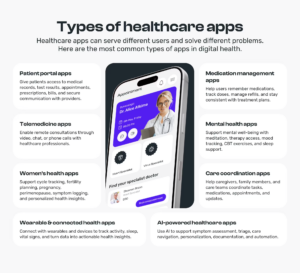
Here are the most common types of apps for healthcare.
Patient portal apps
Patient portals give users access to medical records, lab results, appointment scheduling, provider messaging, prescriptions, bills, and care instructions. These apps are often connected to healthcare organizations and help patients manage their relationship with a clinic, hospital, or care network.
Telemedicine apps
Telemedicine apps allow patients to speak with healthcare providers remotely through video, chat, or phone consultations. They usually include scheduling, intake forms, provider matching, secure messaging, payment, prescriptions, and follow-up care.
Medication management apps
Medication management apps help users remember when to take medication, track doses, manage refills, and sometimes share updates with caregivers or providers. These healthcare apps can be especially useful for chronic condition management and older patients.
Mental health apps
Mental health apps may include meditation, therapy access, coaching, mood tracking, CBT-based exercises, breathing tools, sleep support, or mental wellness programs. In this category, trust, tone of voice, onboarding, and habit formation are especially important.
Women’s health apps
Women’s health apps often support cycle tracking, fertility planning, pregnancy, symptom logging, perimenopause, and personalized educational content. These products depend heavily on personalization, privacy, and long-term engagement.
AI-powered healthcare apps
AI-powered healthcare applications can support symptom assessment, triage, patient guidance, care navigation, personalization, documentation, and administrative automation. However, AI in healthcare should be positioned carefully. It should support users and healthcare professionals, not replace clinical judgment.
Care coordination apps
Care coordination apps help caregivers, family members, and care teams stay aligned. They may include shared calendars, task lists, medication schedules, secure document storage, updates, notes, and role-based access.
Wearable and connected health apps
Wearable health apps connect with devices such as rings, watches, glucose monitors, blood pressure monitors, or sleep trackers. The main value is not just data collection. The app needs to turn health data into clear, actionable insights.
8 successful healthcare apps and what businesses can take from them
The best healthcare apps are not successful because they try to cover every possible use case. They usually win because they make one important healthcare workflow easier: booking care, managing medication, accessing records, tracking health, coordinating caregivers, or turning health data into practical insights.
Below are 8 successful healthcare apps and the business lessons companies can learn from them.
Common features successful healthcare apps share
Successful healthcare apps can serve very different purposes, but they usually rely on the same product foundations: simple access, secure communication, useful reminders, clear data, and workflows that are easy to complete.
Here are the features many strong healthcare applications have in common.
Easy onboarding
Users should quickly understand what the app does and complete the first important action: book a visit, add medication, connect a provider, create a health profile, or start tracking progress.
Scheduling and appointment management
Many healthcare apps for patients include appointment booking, rescheduling, cancellations, reminders, and visit details. This reduces friction for users and manual work for healthcare teams.
Secure messaging
Secure communication helps patients, providers, caregivers, and support teams exchange updates, questions, care instructions, and follow-up information.
Notifications and reminders
Reminders can support medication adherence, appointments, daily check-ins, care tasks, and follow-up actions. The key is to make notifications helpful, not overwhelming.
Health records access
Patient portals and other healthcare mobile apps often give users access to lab results, visit summaries, prescriptions, care plans, and medical history.
Telemedicine functionality
For virtual care products, users need more than a video call. The full flow should include onboarding, intake forms, scheduling, consultation, prescriptions, and follow-up.
AI-powered features
AI can support symptom assessment, care navigation, personalization, documentation, and administrative automation. In healthcare, it should support decisions and workflows, not replace clinical judgment.
Dashboards and analytics
Providers, caregivers, and administrators often need dashboards to track patient activity, care tasks, adherence, engagement, or operational performance.
Wearable integrations
Connected healthcare apps can collect data from rings, watches, glucose monitors, blood pressure devices, or other wearables. The real value comes from turning data into clear insights.
Personalization
Personalized reminders, content, goals, care plans, and health insights can make digital health apps more relevant and improve long-term engagement.
The main lesson: features should come from the workflow, not from a generic checklist.
Before building a healthcare app, businesses should define who will use it, what problem it solves, what data it handles, and which action should become easier for the user. For the first version, fewer well-designed features are usually better than an overloaded product.
Closing thoughts
The best healthcare apps do not succeed because they have the most features. They succeed because they solve meaningful healthcare problems in a way that feels simple, useful, and trustworthy.
MyChart improves patient access. Teladoc makes care easier to reach. Medisafe supports medication consistency. Ada helps users navigate health questions. Flo builds long-term engagement through personalization. Headspace makes mental wellness easier to start. Oura turns health data into practical insights. Caring Village helps families coordinate care together.
Different products, different audiences, different business models – but the same core lesson.
Successful healthcare apps fit naturally into real user workflows.
For businesses planning healthcare applications, the best starting point is not “What features should we add?” but “What healthcare problem are we solving first?”
Once that problem is clear, it becomes easier to define the MVP, design the user experience, choose the right technology, and build a product that people actually use.
Start focused. Solve one important problem well. Then expand from there.
You May Also Like

AI security cameras: use cases, advantages, and business value
Read how AI-powered CCTV and AI security cameras detect violations in real time. Explore use cases, benefits, and when businesses actually need AI video surveillance.